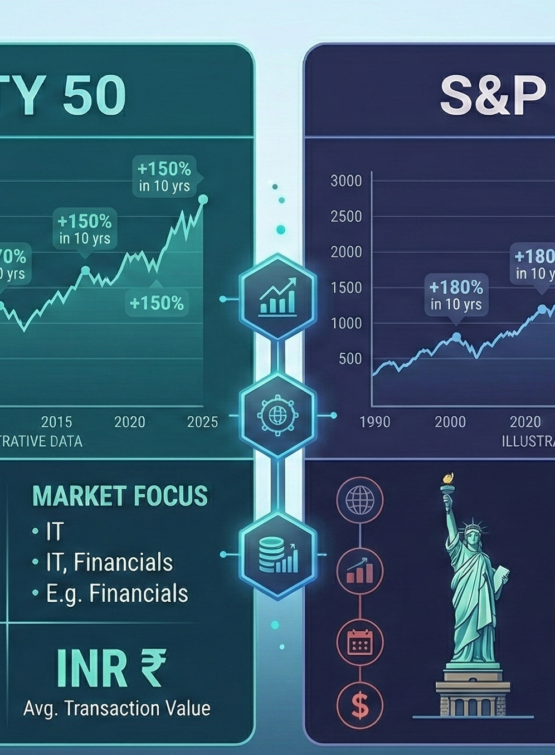
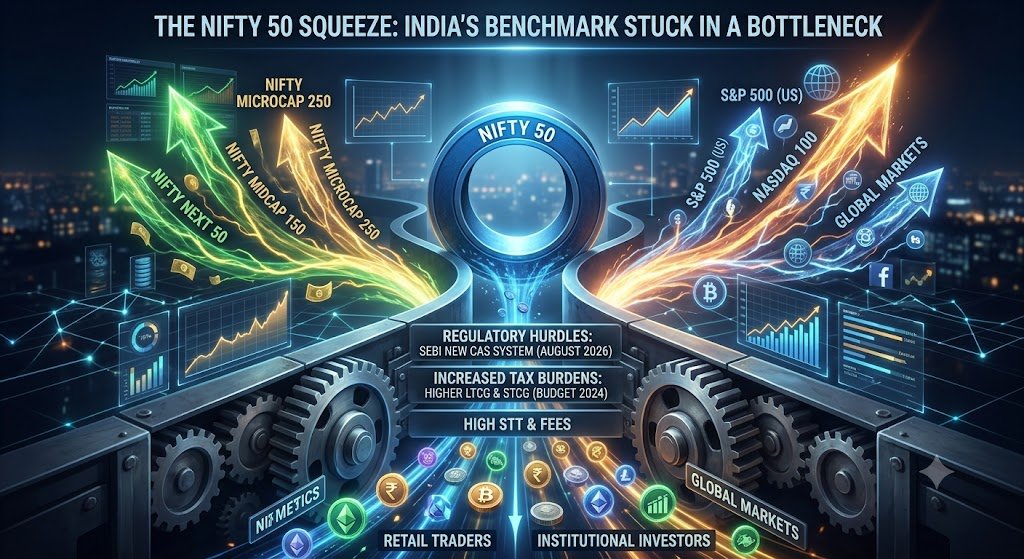
Over the past few years, the Indian stock market has witnessed a fascinating divergence. While the broader market sentiment has largely remained robust, the headline Nifty 50 index has visibly underperformed compared to its domestic smaller peers—such as the Nifty Next 50, Mid Caps, and Micro Caps—as well as major global indices like the S&P 500 and Nasdaq 100.
This underperformance is not merely a cyclical anomaly. It is the result of a complex interplay between changing market dynamics, stringent regulatory interventions by the Securities and Exchange Board of India (SEBI), and an increasingly heavy tax burden on investors and traders.
As of 9th September 2026, the major stock indices stood at distinct levels that reflect this ongoing market divergence. In the domestic Indian market, the benchmark Nifty 50 was trading around 23,431.50, while the higher-growth transition index, the Nifty Next 50, stood at approximately 72,853.85. The broader Nifty Midcap 150 and Nifty Microcap 250 indices were hovering near 22,990.95 and 26,675.30, respectively. Meanwhile, on the global front, the US markets continued to reflect their strong tech-driven momentum, with the S&P 500 reaching roughly 7,636.36 and the Nasdaq Composite climbing to about 26,257.39.
Here is a deep dive into the statistical realities of this underperformance and the policy shifts that have capped the Nifty’s upside.
1. The Performance Gap: Nifty 50 vs. The Rest
Historically, the Nifty 50 has been the bedrock of Indian equity portfolios, prized for its stability and liquidity. However, in the recent bull cycles, capital has aggressively chased higher growth, leaving the top 50 blue-chip stocks trailing behind both domestic mid/small-caps and US tech giants.
Domestic Underperformance
The shift toward broader market indices has been stark. Investors have increasingly favored the Nifty Next 50 (companies ranked 51-100 by market cap) and the Nifty Midcap 150. The Nifty Next 50 tends to capture companies in high-growth transition phases, which has translated into significant alpha generation over the Nifty 50 in recent calendar years. Similarly, mid-cap and micro-cap indices have seen historic rallies, driven by retail participation and domestic institutional inflows.
Global Underperformance
On the global stage, the US markets have been powered by the artificial intelligence boom and robust corporate earnings. The S&P 500 and the tech-heavy Nasdaq 100 have delivered massive compounding returns, effortlessly outpacing the Nifty 50’s growth over the 2023–2025 period.
Comparative Annual Returns (Calendar Years)
| Index | 2024 Return | 2025 Return | 2026 YTD Return | CAGR since 2024 |
|---|---|---|---|---|
| Nifty 50 | 8.80% | 10.51% | -10.25% | 2.87% |
| Nifty Next 50 | 27.45% | 2.02% | 4.72% | 11.53% |
| Nifty Midcap 150 | 23.80% | 5.37% | 2.85% | 12.14% |
| S&P 500 (US) | 23.31% | 16.39% | 11.55% | 19.09% |
Source data: Trading View 12M Charts. The Returns exlcude dividends.
As the data shows, an investor sitting purely in the Nifty 50 missed out on the explosive ~28% growth of the Nifty Next 50 in 2024, as well as the relentless compounding of the S&P 500, which delivered 23.31% and 16.39% in 2024 and 2025, respectively.
2. Regulatory Headwinds: SEBI’s Market Mechanics
Beyond sheer market cycles, regulatory changes have fundamentally altered trading volumes and liquidity in large-cap stocks.
The New Closing Auction Session (CAS) System
Effective August 3, 2026, SEBI introduced a new Closing Auction Session (CAS), initially targeting stocks with Futures & Options (F&O) contracts. This shift changed the transition timeline—moving from the Continuous Trading Session (CTS) into the CAS between 3:15 P.M. and 3:30 P.M.
While designed to ensure accurate closing price discovery and reduce last-minute price manipulation, the CAS system has frustrated many retail traders. By locking orders into an auction matching system during the crucial final 15 minutes of the trading day, it reduced the intraday agility that retail day traders heavily rely on. This friction has contributed to a drop in speculative liquidity in top-tier Nifty 50 stocks.
The Crackdown on F&O Speculation
SEBI also launched a massive crackdown on retail derivatives trading beginning in late 2024 to curb excessive speculation (noting that 90% of retail F&O traders lose money). The strict new norms disproportionately impacted the highly liquid Nifty 50 index options:
- Massive Contract Sizes:The minimum index F&O contract size was hiked from ₹5–10 lakh to ₹15–20 lakh, effectively pricing out smaller retail participants.
- Fewer Expiries:Weekly expiries were restricted to just one benchmark per exchange, drastically reducing the high-frequency trading volume that historically kept large-cap indices buoyant.
- Upfront Premiums & Strict Margins:The removal of calendar spread benefits on expiry days and the demand for upfront premium collections forced traders to pull back their leverage.
3. The Tax Sting: Budget 2024’s Toll on Equities
Perhaps the most structural drag on the Nifty 50’s performance has been the taxation overhaul. The Union Budget of 2024 introduced sweeping hikes to capital gains and transaction taxes, directly eating into the net returns of domestic investors and foreign institutions alike.
- Long-Term Capital Gains (LTCG): Hiked from 10% to 12.5%. This 25% relative increase in the tax burden discouraged long-term holding of mature, slower-growing large caps, pushing investors to seek higher-yielding midcaps to offset the tax drag.
- Short-Term Capital Gains (STCG): Spiked from 15% to 20%. This severely impacted swing traders and short-term positional investors who typically operate in highly liquid Nifty 50 stocks.
- Securities Transaction Tax (STT): Hiked across F&O trades, increasing the friction cost of hedging and trading.
Because the Nifty 50 relies heavily on institutional flows, foreign portfolio investors (FPIs), and high-frequency trading for its momentum, these tax hikes acted as a direct headwind. When transaction costs and taxes rise, capital naturally migrates—either to higher-growth domestic micro/mid-caps where the gross return justifies the tax, or to global markets like the US, which offer better risk-adjusted technological growth.
Summary
The Nifty 50 remains the anchor of the Indian economy, providing undeniable downside protection during market corrections. However, its recent relative underperformance is a clear reflection of a changing environment. A combination of SEBI’s aggressive de-leveraging of the retail F&O space, the friction introduced by the new CAS mechanism, punitive capital gains tax hikes, and an unprecedented tech rally in the US have temporarily stripped the Nifty 50 of its growth premium. Until large-cap corporate earnings growth accelerates enough to offset these structural costs, capital will likely continue hunting for alpha in the broader and global markets.
Disclaimer:
I provide the information and my views on the website only to educate people, new investors, and stock market enthusiasts on equity and other market investments. Please consult a SEBI registered financial advisor before making any investments in the stock or commodity markets. In case of any queries, you can contact me on Contact Form or email: admin@valueinvestingonline.in.